Pages

Egyptian Writing

Egyptian Writing Facts for Kids

Egyptian Writing
Egyptian Writing
The ancient Egyptians thought it was important to write down information about religion and important events.  So they invented scripts (ways of writing).  There are three main Egyptian scripts.

  • Hieroglyphics, or ‘sacred writing’. The most famous script is hieroglyphic, which uses pictures as symbols.  Hieroglyphics were carved or painted on stone monuments, tombs where the dead were buried, and temples where the gods were worshipped. 
  • Hieratic, or ‘priests’ writing’.  Hieroglyphics were too difficult to use as handwriting so a simpler form was invented so that the priests could write records on papyrus. Hieratic writing still used pictures as symbols. 
  • Demotic, or ‘people’s writing’ developed from hieratic writing but was much simpler and had no pictures.  Unlike hieroglyphics or hieratic this was in common use. Like hieratic writing, it was written on papyrus, the earliest form of paper which was made from papyrus reeds. 

Egyptian Writing Facts for Kids
Hieroglyphic writing

Hieroglyphics were carved or painted by the priests and scribes.  At first Egyptian hieroglyphics were simply pictures.  They showed simple things, such as the sun, plants, parts of the body and animals.  Later the hieroglyphics came to mean more.  A symbol of the legs not only meant legs, but also walking.  An arm not only meant an arm, but also strength.  A symbol of an eye meant first an eye, and an eye with a teardrop meant sadness.

This way of writing could not say everything.  For example, the scribes could not write ‘he’ or a person’s name.  They could not show the difference between ‘walk’ or ‘walked’.  So some symbols were chosen to represent sounds.

For example, the picture of a house meant the sound ‘pr’ because that was the Egyptian word for a house (we do not know exactly how Egyptian was pronounced).  So if, for example, you wanted to write the English word ‘price’ using ancient Egyptian hieroglyphics, you would start with a picture of a house.  (This would not be the ancient Egyptian word for price, simply the English word using Egyptian hieroglyphics.)


There are nearly 2000 Egyptian hieroglyphs.  For example we have

Hieroglyphs showing single sounds; below we have the sounds k, h, s, t, and n.

Hieroglyphs showing what someone is doing: below we have five different hieroglyphs which mean 

1) a man or, if there were more than one, people; 
2) praying;  
3) hiding;  
4) being tired,  
5) dying, a dead enemy.

Hieroglyphs of agriculture and crafts: below we have five hieroglyphs which mean  

1) to loosen the soil, to dig the ground; 
2) to cut the crops with a sickle;  
3) to measure the cereal crops (the Egyptians grew barley and a cereal called emmet);  
4) to crush salt (which came in blocks); this can also mean ‘heavy’;  
5) to bake bread ( this is a picture of the long shovel which bakers still use to put loaves into a hot oven and to pull them out again).

All of these hieroglyphs can also be used to represent sounds.  The last symbol above, the baking bread symbol, can also mean the sound of the letters rth, or hnr, or hnj.  Vowel sounds, a,e,i,o,u are not shown at all (as they are not shown in modern Arabic or Hebrew writing) so you need to imagine what these combinations sounded like: hnr may have sounded ‘hanur’ but we really do not know.

So you can see that ancient Egyptian is a very, very difficult language to learn to read!

For nearly 2000 years after the end of Egyptian civilisation no-one could read these scripts.  Scholars studied them but were unable to decipher them (work out what they meant).  They thought the hieroglyphic writing was simpler than it really is: the pictures were taken as drawings of real things rather than symbols.

Hieroglyphic and demotic writing were finally deciphered by a French scholar called Champollion.  He studied a piece of black stone which had been found in Egypt and which was covered with three kinds of writing.  The upper part was in hieroglyphics, the middle part was in demotic, and the lowest part was in Greek.

Rosetta Stone

Since he was able to read the Greek text, Champollion was able to work out the rest.  This black stone is known as the Rosetta Stone, after the place in Egypt where it was found.  It is one of the most important treasures of the British Museum in London.

Rosetta Stone
Rosetta Stone
Egyptian Literature 

In addition to keeping records of religious rituals and government actions, the Egyptians wrote many other works from the time of the Old Kingdom.
  • collections of wise sayings, such as The Advice of an Egyptian Wise Man, which gave warnings to the king and foretold of better times ahead; 
  • love poetry and religious humns, of which the best known is King Akhnaten’s hymn of praise to Aten, the sun’s dsic; 
  • stories of seafaring and travel, such as the Story of Sinuhe from the 12th dynasty and the Journey of Unamon from the 20th dynasty. these both tell of voyages to the land of Canaan.

Egyptian Science

Egyptian Science Facts for Kids

Egyptian Science Facts for Kids
Egyptian Science The ancient Egyptians are famous for many scientific achievements:

  • metal working, including working with copper and gold: 
  • glass-blowing: 
  • knowledge of anatomy and medicine; 
  • invention of a calendar; 
  • the standardisation of measurement; 
  • paper-making from papyrus reeds; 

Egyptian Metal Working
Metal working

The ancient Egyptians learned how to heat metal ores in order to extract the metals. They were skilled metal-workers, particularly in copper and in gold. The picture below shows workmen pouring molten (gold made liquid through heating) into moulds.

Egyptian Glass-blowing

Glass-blowing

The ancient Egyptians may have been the first people to learn how to make glass. They learnt how to heat sand in a very hot furnace and then blow the molten sand into glass. They made glass jars and glass beads. The pictures below show an ancient Egyptian glass jar and a wall painting of workmen blowing glass in a furnace.

Knowledge of anatomy and medicine

The Egyptians knew about the anatomy of the human body. They were able to remove the organs of the body, such as the heart and liver and intestine after a person had died without needing to cut the body completely open.

There is a papyrus dating from 1600 B.C. in which the different organs of the body are identified. (It is known as the Edwin Smith papyrus after the man who deciphered it (worked out what it meant).) The papyrus also explains that blood is pumped round the body from the heart (this knowledge was lost and not rediscovered for another 2000 years).

Egyptian The calendar
The calendar

Egyptian scientists observed the movement of the stars across the sky. They realised that the annual flood of the Nile happened at the same time as a particular pattern of stars.

From very detailed records year after year they were able to work out that this constellation of stars was in exactly the same place after 365¼ days. The ancient Egyptians gave us our calendar year. This allowed them to forecast when to expect the flood each year.

Egyptian The Standardisation of Measurement
The standardisation of measurement

The Egyptians were very quick to understand that units of measurement needed to be standardized.

The easiest way to measure something is to compare to some part of your own body. In early civilisations the units of length were defined as parts of the body. The Egyptian cubit, therefore, was the length of the forearm, from the elbow to the fingertips. Other measurements of length could be the hand, the pace or the double pace, the full length of both arms outstretched, or the breadth of the forefinger.

Weight could also be measured in terms of a container. Before measurements were standardised you might buy a basket of corn, or even a boatload.

The Egyptians understood that these measurements could vary. One person’s forearm is likely to be shorter or longer than another person’s. Also the measurements were not related to each other. A basket of corn is not a 100th part of a boatload of corn. A forearm is not twice the length of a pace.

So the ancient Egyptians ‘standardised the units. The Egyptian cubit was now the length of a certain bar of metal, or sometimes wood, which was kept carefully in the royal palace or temple.

Once the Egyptians had standardised the cubit, they based all other measurements on it, so that every measurement was either a fraction or a multiple of a cubit. The Egyptian measurement of area, the ‘setat’ was defined by a square with sides 100 cubits long.

Egyptian Science
Egyptian Science
Paper-making from papyrus reeds

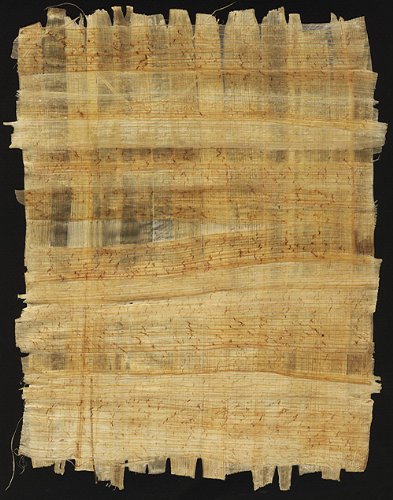
Papyrus is a reed that grows in the swamps of the Nile delta (the delta is where the Nile divides into several channels before joining the Mediterranean). The Egyptians were the first people in the world to understand that this reed could be harvested and made into a material on which people could write.

Below is a photograph of the Edwin Smith papyrus from 1600 B.C. (see anatomy and medicine above). This is written in hieratic script (see Egyptian Writing).

Surveying

The ancient Egyptians achieved wonders in surveying from building the pyramids (see Egyptian architecture) to accurate measurement of perfectly rectangular fields.

They used:
  • a sighting instrument called a merchet, through which the surveyor looked at a fixed vertical line in the distance; 
  • a plumb line, which is a line with a heavy weight on the bottom; a plumb line hangs in a perfect vertical line; 
  • a measuring rope which was tightly stretched between two points; a new measuring rope was stretched and treated with beeswax and resin so that it kept the same length; 
  • a groma, an instrument that showed a perfect right-angle, used for laying out fields.

Egyptian Daily Life

Egyptian Daily Life Facts for Children

Egyptian Daily Life Facts for Children
Egyptian Daily Life Egypt is a dry, hot desert country and ancient life depended on the waters of the River Nile. The Nile was used for:

  • water to irrigate the fields; 
  • the main means of travelling and of transporting goods, all by boat; 
  • an important source of protein food when people caught fish; 
  • the main building material was mud brick 


Egyptian Daily Life Houses
Houses

People lived beside the Nile and Egyptian houses were almost all built from bricks of Nile mud. (The palaces of the Pharaohs were built from stone.) The mud was carried in baskets from the Nile and poured into moulds. When the mud in the mould was dry, it was turned out and left to bake in the heat of the sun.
A house built from mud bricks:
  • was cool inside. 
  • had a flat roof so that in very hot weather people could sleep on the roofs in the cool of the night. 
  • often had courtyards with walls built round them. 
  • Cooking was done out of doors in the courtyard. 
We know about Egyptian daily life from the huge number of wall paintings in tombs and temples. The houses we are shown are the houses of wealthier people, priests and scribes, government officials, and master craftsmen. The paintings show a large number of servants, or probably slaves, working in the houses. From the paintings we know that the servants:
  • looked after the charcoal fires; 
  • ground wheat to make bread; 
  • cooked meat over fires; 
  • carried baskets full of vegetables. 
The richer families in ancient Egypt had houses with beautiful gardens, looked after by slaves or servants. Men went wild-fowling (hunting wild duck) in the marshes and women are shown sitting on couches talking to each other and listening to music.

Games and entertainment

Children played with toys such as spinning tops and wooden models of animals which they could pull along on strings. They played with balls made of clay and they played at leapfrog. Girls played dancing games, holding hands in a ring, and little boys played at being soldiers.

Adults played a number of board games. We know that they played a game for two people called Senet on a board with 30 squares. The aim was to reach the kingdom of Osiris through all the dangers on the way.

The Egyptians also enjoyed story-telling, parties and music. There were a number of great public festivals, such as the celebration of the resurrection of Osiris (see Egyptian religion) where thousands of people danced to the music of harps and flutes.
Egyptian Daily Life Farmers
The Farmers

The vast majority of people in Egypt, however, were farmers who farmed the fields on the bank of the Nile. Men, women and children from a young age all worked in these tiny fields.
  • They ploughed the land with a wooden plough pulled by oxen.
  • They sowed the fields with seed and watered the ground with water from the Nile. 
  • They harvested the grain using a sickle. 
  • They threshed (beat out the grain from the husk) it by getting their oxen to walk round and round treading on it. 
  • All the grain was controlled by royal officials and kept in a royal granary. 
You may remember the story of the Pharaoh who dreamt of the seven fat cattle followed by the seven lean cattle. Joseph interpreted his dream, telling him that there were going to be seven very good harvests, followed by seven poor harvests.

He advised the Pharaoh to collect the grain during the seven good years so that the people would not starve during the seven poor years. This story is more evidence that the grain was controlled by the Pharaoh’s government and was then distributed when necessary.

Food

  • The crops and vegetables meant that even the poorer Egyptians usually ate a balanced diet.
  • The staple food was bread from the grain. 
  • They grew onions and leeks and salad vegetables 
  • They grew beans and dried them so that they could be cooked and eaten throughout the year 
  • They grew fruit such as figs and pomegranates. 
  • They caught fish from the Nile. 
  • They kept cattle. 
  • They made beer from barley and richer people drank wine made from grapes. 
Clothes

Farmers also grew flax. Linen cloth is made from flax and Egyptian clothing was made from linen. Men wore a short linen kilt and women usually wore a linen tunic that hung from their shoulders. Little children sometimes wore no clothes at all but often wore jewellery round their neck.

Egyptian Daily Life - Egyptian Daily Life Facts for Children
Trades 

Although most people were farmers, there were many other trades, carpenters, metal-workers, bakers, goldsmiths, boat builders. Trade was carried out by way of exchanging goods. For example, a farmer might exchange a basket of onions for a bag of charcoal, or a cow for a small boat.

Everything in Egypt depended on the Nile and everything was transported on boats and ships on the river.

In order to fish and to transport goods from one place to another people had small boats made of papyrus stalks bound together. Bigger boats and larger ships were made of wood, which was mostly imported from Lebanon.

We have many paintings of boats carrying cattle and other heavy goods on the Nile. It was a very busy river with constant traffic.

Egyptian Art

Ancient Egyptian Art Facts for Children

Ancient Egyptian Art Facts for Children
From the earliest times Egyptian art was developed in the service of the king. Ancient Egyptian art was first created to show that the king was a god. The art-forms were first of all worked out by the master craftsmen in the Pharaoh’s court. Their ideas and fashions were then followed carefully by lesser craftsmen who worked for ordinary Egyptians.

Pictures 

The earliest work of art that we can give a date to is the Palette of Narmer, who was the first king of the first dynasty, about 3000 B.C. (5000 years ago). This palette shows Narmer’s victories. It is carved with ‘reliefs’ which means that the artist has carved away the slate background to make the pictures stand out.

This early picture does not show any ‘perspective’. That is, it does not show any depth or space (think of a modern painting of a country lane, showing the lane stretching away into the distance – that is perspective).

For the next 3000 years, Egyptian pictures showed little change from this early example. Pictures were either carved in relief on stone or slate, or they were painted on walls. In both cases, the pictures are ‘two dimensional’ showing no depth. 

The craftsmen from the 4th dynasty onwards produced wonderful wall paintings, of people’s daily life and the birds and plants that were around them. These paintings are found on the walls of the tombs where the dead were buried. It was hoped that in the life after death, the pleasant life shown in the paintings would continue for the dead person.

The upper picture here shows people trapping birds and the lower picture shows people ploughing. Below is a brightly coloured picture of Geese. Both these paintings were painted on the walls of Egyptian tombs of the Old Kingdom more than 4500 years ago.

In the Middle Kingdom, the same art forms continued: we can see from the picture below a number of features that are common in Egyptian pictures throughout the Old, Middle and New Kingdoms.

Egyptian Art Pictures
  • The bodies of the figures are facing us, but their heads are in profile (turned sideways). 
  • The body of the Pharaoh, if shown, is always very stiff and formal, as in the Narmer palette, but the bodies of ordinary people are more relaxed and life-like, as in the picture of people ploughing. 
  • The Pharaoh is always larger than any other figures in the picture. 
  • All the pictures are two-dimensional, without any depth. 
Sculpture

From the 3rd Dynasty onwards, Egyptian art began to produce sculpture as well as carvings and paintings. The most exciting time for this art was the 4th Dynasty when the Pyramids were built. The picture below shows King Mycerinus between two goddesses. The statue was made around 2600 B.C. (4600 years ago). Later Egyptian sculpture followed this style for 2000 years. The statues are life-like, always facing forwards (unlike the paintings), and are made from hard stone which has lasted well.

sculpture of egyptian art
Sculpture of Egyptian Art

Egyptian sculpture

  • Shows human faces as they really were. 
  • Has the figures facing directly forwards. 
  • The figures are standing or sitting upright and are very stiff and formal. 
History for Kids 10 Blogspot
Applied Art

During the New Kingdom, wealth flowed into Egypt and the master craftsmen used precious metals such as gold and precious stones to produce jewellery and to decorate the mummy-cases in which the mummified bodies of pharaohs and rich officials were placed.

The best example of a highly decorated sarcophagus(mummy-case) that has survived is that of the Pharaoh Tutankhamen. The sarcophagus is made of solid gold and beautifully decorated by the master craftsmen.

Top 10 Kids & Family Movies

The 10 best kids movies to watch as a family. 

Top 10 Kids & Family Movies - Best of History for Kids 10

1. The Wizard of Oz (1939)

Top 10 Kids & Family Movies
2. Inside Out (2015)

Inside Out (2015)
Inside Out (2015)
3. E.T. The Extra-Terrestrial (1982)

E.T. The Extra-Terrestrial (1982)
4. Snow White and the Seven Dwarfs (1937)

Snow White and the Seven Dwarfs (1937)
5. Toy Story 3 (2010)

Toy Story 3 (2010)
Toy Story 3 (2010)
6. Toy Story 2 (1999)

Toy Story 2 (1999)
Toy Story 2 (1999)
7. Up (2009)

Up (2009)
Up (2009)
8. Finding Nemo (2003)

Finding Nemo (2003)
Finding Nemo (2003)
9. Pinocchio (1940)

Pinocchio (1940)
Pinocchio (1940)
10. The Jungle Book (2016)

The Jungle Book (2016)

The Pyramids

Ancient Egyptian Architecture Facts for Children

The Pyramids 

The ancient Egyptians are famous for the building of the Pyramids. The pyramids were built as the burial places of the Egyptian kings from before the start of the Old Kingdom until the end of the Middle Kingdom. Because the Egyptians kept religious and government records, we are able to read about the building of some of these pyramids.

The Step Pyramid at Saqqara

The Step Pyramid at Saqqara

  • The Step Pyramid at Saqqara is the earliest pyramid that is still there today.
  • The Step Pyramid was built in 2630 B.C.
  • It was the burial place of King Djoser. 
  • The architect of the Step Pyramid was Imhotep.
  • Imhotep was the High Priest of Ra, the sun-god. He became famous for his great wisdom and knowledge. The Egyptians later worshipped Imhotep as a god.
  • The Pyramid rose in six giant steps.
  • These steps were meant as a huge stairway for King Djoser to climb up to join Ra, the sun-god. 


There are still over eighty pyramids in Egypt today. They are all more than 3000 years old. The architects of these pyramids were very skilled in mathematics, in technical drawing, and in knowledge of the position of the sun and stars. The pyramids were carefully designed to be in a straight line with, for example, a certain star constellation at a certain time of year, or sunrise on a particular day.

Some of the pyramids were built as step pyramids like the one at Saqqara, but many others were a real pyramid shape, with sides that were smooth and sloping.

The Great Pyramid at Giza

The Great Pyramid at Giza

  • The most famous of all the true pyramids is the Great Pyramid at Giza, which is the largest of the three Giza pyramids. 
  • The Great Pyramid was built in 2528 B.C. for King Khufu, which means that it is more than 4500 years old. 
  • It is the oldest of the Seven Wonders of the Ancient World. 
  • It was the tallest building in the world for more than 4000 years, until the 20th century. 
  • It is built from over 2 million huge blocks of limestone. 
  • It was covered with great smooth slabs of white limestone, but these were later removed to build the city of Cairo. 


Because the pyramids were the burial places of kings, they were full of treasure. All the king’s riches and belongings were buried with him to keep him happy in the afterlife.

Robbers tried to break into the pyramids to steal the treasure. So the architects tried to fool the robbers:

  • Each pyramid had only one true entrance, but several other, false, entrances were made. 
  • The inside of the pyramid had lots of false doors and false passages which led to rooms filled with rubble or blank walls. 
  • The doors were built of granite and were almost impossible to move. Even if the robbers managed to open a door, they might find a blank wall behind it.


However, almost all the royal tombs were eventually broken into and all the treasure removed.

The Temples

Ancient Egyptian Architecture Facts for Children
The Egyptians also built magnificent temples, which they believed were the homes of the gods and goddesses. The temples were added to over the centuries so several architects helped to plan them.

  • The temples were built of stone, as at Luxor, or built into the solid rock, as at Abu Simbel.
  • The temples were filled with high stone pillars which supported a heavy stone roof.
  • The walls were covered with carvings showing the pharaoh’s victories in war. The pictures also showed the pharaoh together with the gods.
  • Many of the temples contained enormous statues of the pharaoh.
  • The temple at Abu Simbel has four huge statues of the Pharaoh Ramses the Second, 20 metres high, wearing the double crown of Upper and Lower Egypt. 


There are also several temples at Luxor with statues of the Pharaoh Ramses the Second, who was worshipped as a god. 

The building of a temple was accompanied by rituals connected to the worship of the goddess Seshat, ‘The Mistress of the House of Architects’. All the rituals had a practical side and the Pharaoh played an important role.

The words spoken by the Pharaoh at the ritual of making the measurements on the ground are recorded in hieroglyphics on a temple wall:

“I hold the peg. I grasp the handle of the club and grip the measuring cord with Seshat (Goddess of Architects). I turn my eyes to the movements of the stars. I send forth my gaze to the Bull’s thigh (the star constellation of the Great Bear). I count time. I watch the clock. I establish the four corners of your temple.”